The Canada Drive–American Avenue Bridge carries a two-lane roadway over Highway 400 in Vaughan, providing a direct connection between Canada Drive and American Avenue.
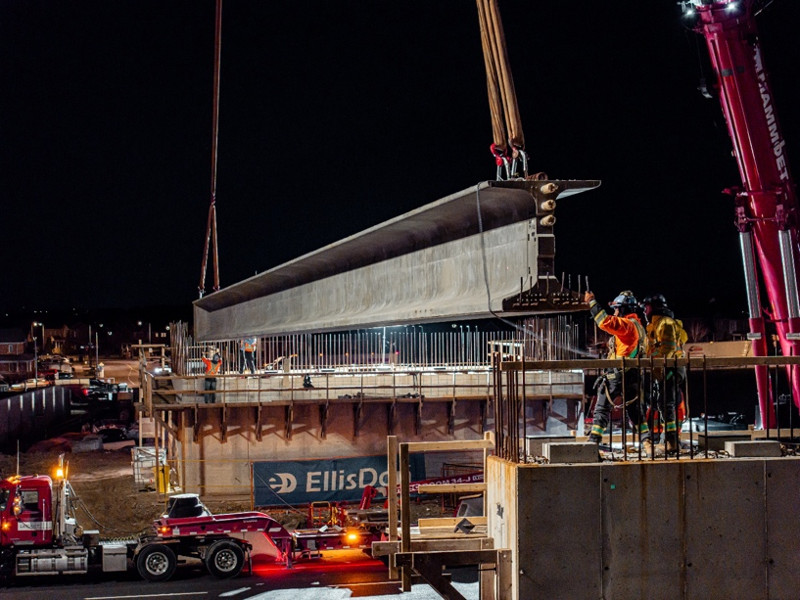
The structure is designed to support multiple means of transportation, incorporating sidewalks and dedicated bicycle lanes on both sides of the bridge deck. This crossing enhances overall network connectivity and helps redistribute local traffic volumes, reducing dependence on adjacent arterial routes such as Teston Road and Major Mackenzie Drive.
Why Precast Concrete?
The City of Vaughan gained key advantages by choosing precast concrete for this bridge project. Plant-controlled fabrication ensured consistent quality and avoided weather-related curing delays, while enabling concurrent site work and girder production to shorten the schedule. Precast also offers design versatility for customized shapes and finishes, and off-site production reduced site congestion, dust, and waste, improving safety and environmental performance.
Prestressed & Post-Tensioning Hardware
Unlike typical NU1400 prestressed girders, these were modified to incorporate post-tensioning in addition to prestressing. This option was selected for this application due to their superior span-to-depth ratio and enhanced structural efficiency. These girders provide increased load-carrying capacity while allowing for longer spans and fewer supports, resulting in a more streamlined structural profile.
The prestressed, post-tensioned girders are well-suited for both straight and curved alignments and can be adapted for a wide range of bridge applications, offering flexibility in design.
The system was chosen to satisfy both span and clearance requirements, as a purely prestressed option would require a deeper girder and reduce clearance below.
Project Challenges and Solutions
Temperature Differential Control
Due to the geometry of the girder, special cooling techniques were required to ensure uniform heat dissipation, prevent thermal distortion, and avoid residual stress that could compromise structural integrity.
Reinforcement Congestion
High reinforcement density created fabrication challenges. This was mitigated through the use of detailed modeling which allowed for improved constructability, reduced assembly time and overall streamlined fabrication.
Tolerances for Post-Tensioning Components
This introduced a significant challenge, requiring specialized solutions to maintain precise positioning throughout the casting process and ensuring that alignment and dimensional accuracy were consistently achieved.
Fast Installation
Installation was completed at night with planned overnight rolling closures to ensure safe operations while minimizing disruption to Highway 400 traffic.
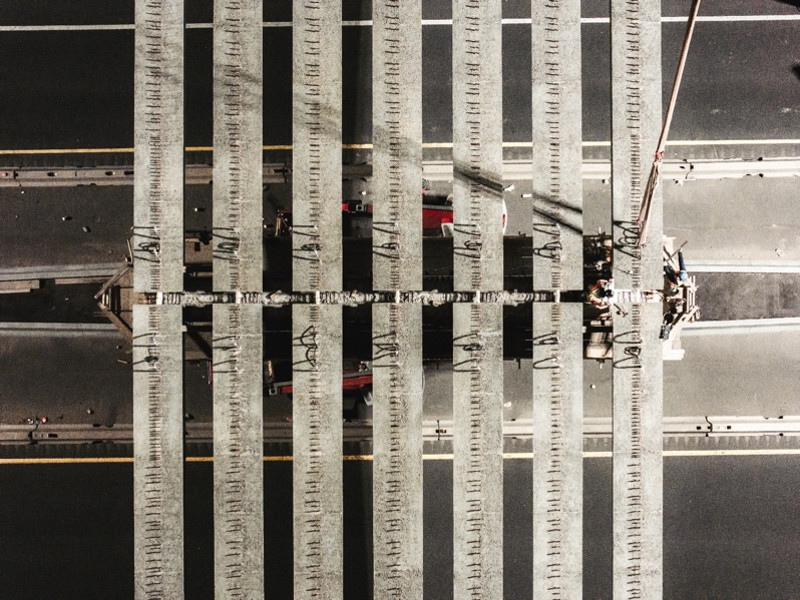
A total of fourteen modified NU1400 girders were erected (seven per structure), with an average installation time of just 30 minutes per girder.
Night 1:
- Start: April 17, 2025 – 12:30 AM
- End: April 17, 2025 – 4:40 AM
Night 2:
- Start: April 23, 2025 – 12:30 AM
- End: April 23, 2025 – 4:30 AM
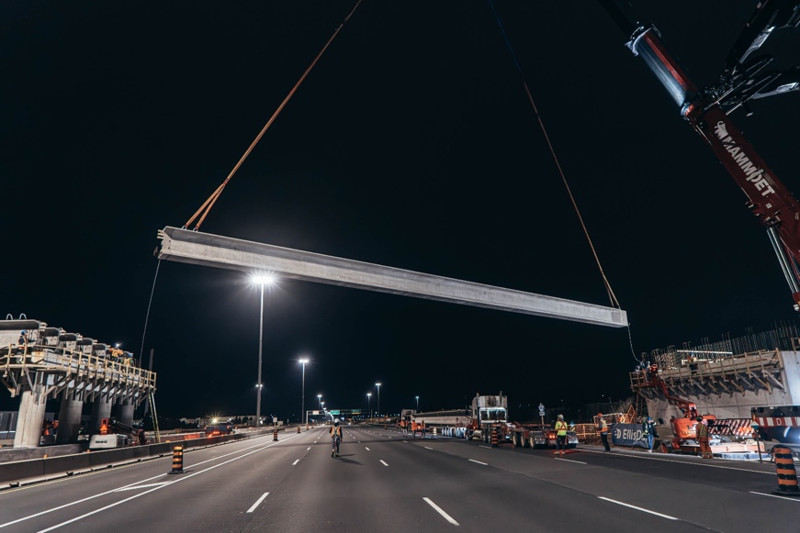
DECAST supplied one of the first bridge projects in Ontario to utilize precast concrete girders incorporating both pre-stressing and post-tensioning systems. The NU1400 designation refers to a 1400 mm deep, I-shaped girder, with each unit for this project measuring approximately 40.5 metres in length.
The girders were stabilized using intermediate bracing and secured with four 20 mm diameter dowels at both ends of each girder. These were installed with a 225 mm setback from the centre of the 250mm x 525mm x 20mm bearing pads. Exterior bearing locations utilized larger pads measuring 350mm x 450mm x 70mm to accommodate increased load demands and ensure proper distribution.
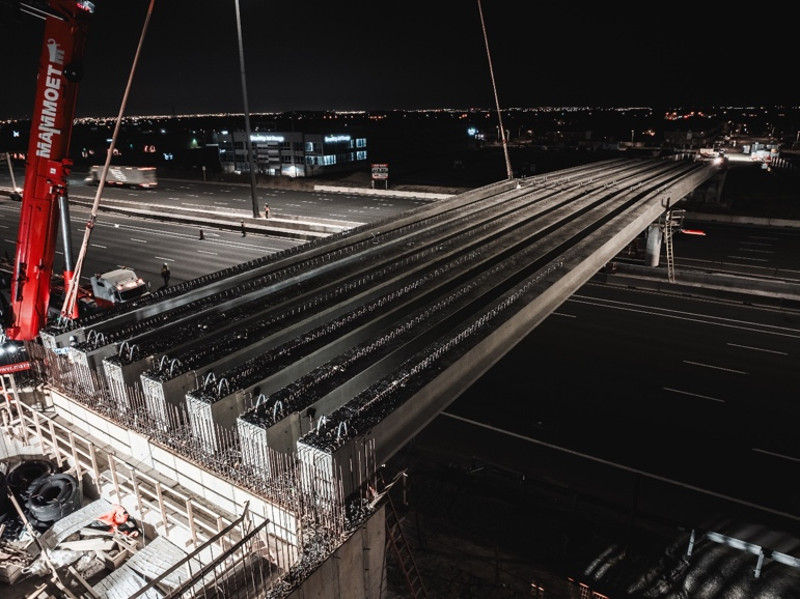
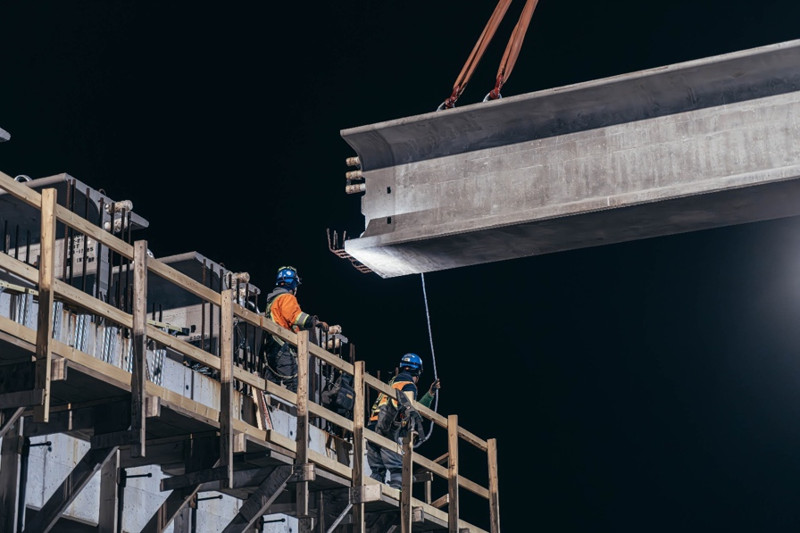
Installation was executed as a night operation to minimize disruption to traffic and commuters. Girders were transported to site under coordinated logistics planning and lifted into place using heavy-lift cranes. Each girder was set with precision, ensuring proper alignment, bearing, and continuity-resulting in an efficient and seamless installation process. Once the girders were erected, high-strength steel tendons were inserted into these ducts and stressed using hydraulic jacks anchored at each end of the girder.
Key Project Partnerships
Project success was driven by close collaboration between DECAST and key partners across design, fabrication, and installation. The City of Vaughan provided oversight and alignment with project goals, EllisDon led construction and bridge engineering, BBR Canada integrated post-tensioning requirements through early coordination, and Entuitive delivered specialized structural engineering support—ensuring a safe, efficient, high-quality bridge for generations to come.
Photos courtesy of PAVIC (PAVIC)
- OwnerCity of Vaughan
- Precast SupplierDECAST
- EngineerEntuitive
- ContractorEllisDon Civil Ltd

Imagineering Magazine
View our latest issue of the popular Imagineering Magazine.
