The 900 Saint-Jacques project, located in the heart of Montreal’s Quartier des Gares, stands out as a striking example of contemporary urban architecture. With its 64 floors, the tower asserts itself as a visual landmark in the downtown area while engaging with its surrounding context, composed of historic buildings and modern architecture. The tower’s precast concrete panels echo the materiality of local monuments, from older gray-stone buildings to Brutalist-era landmarks such as Place Ville-Marie and the Olympic Stadium.
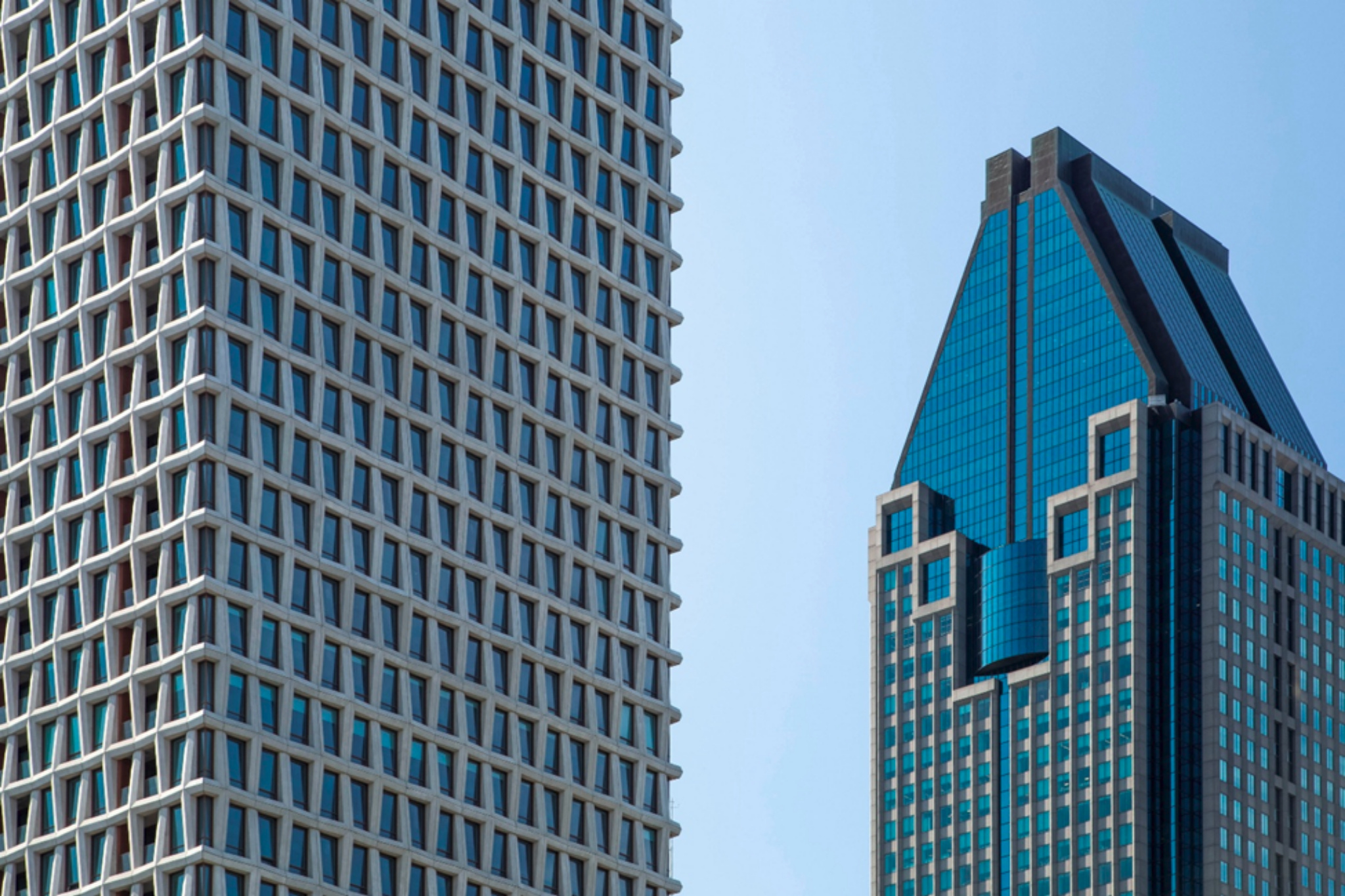
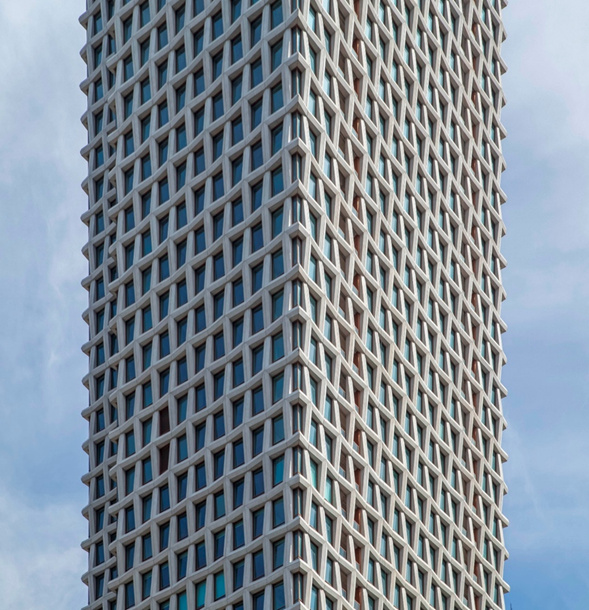
The architectural envelope is the project’s primary defining feature. The façade consists of fine-aggregate concrete panels arranged in a pattern reminiscent of weaving, creating light and shadow effects that evolve throughout the day. This texture gives the building a sculptural presence while ensuring excellent thermal and acoustic performance.
While the hotel’s panels have relatively conventional, “flat” profiles, those of the apartment tower are angled inward and outward, enlivening the façades with a dimensional, “woven” appearance. This texture, combined with the relatively high ratio of solid to glazed portions of the envelope, gives the building a distinctive presence on a skyline dominated by glass façades. This ratio also enhances performance: energy modeling indicates that the building envelope is 25% more efficient than a generic curtain wall.
Winner of the 2025 Canadian Architect Award of Excellence – For more information: https://www.canadianarchitect.com/900-saint-jacques/
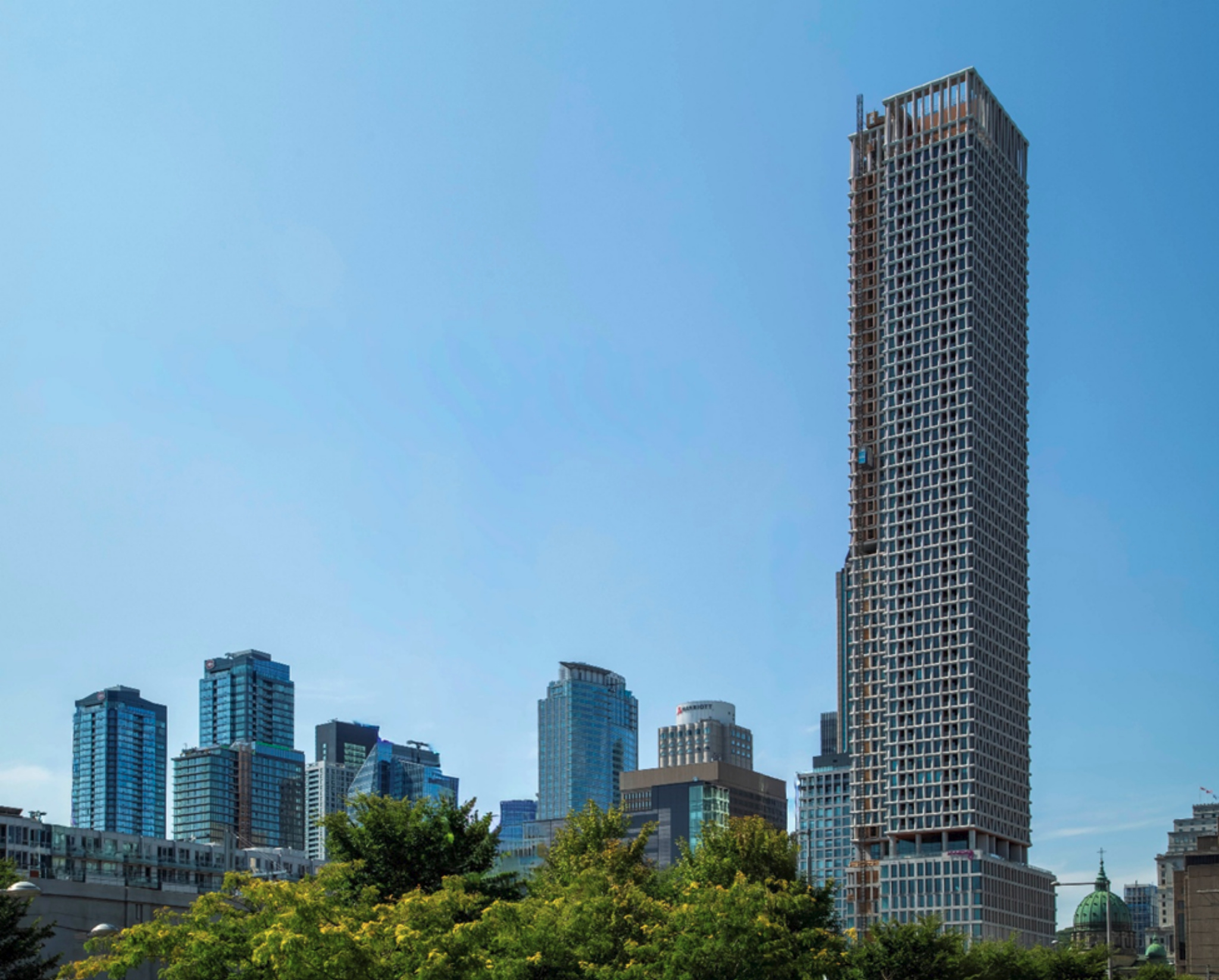
The use of precast concrete in the 900 Saint-Jacques project is characterized by a combination of technical innovation, manufacturing precision, and operational efficiency. With a total of 4,957 m³ of concrete, the prefabricated envelope represents an exceptional volume, requiring careful management of storage, production, and installation sequences. The high repetition of elements allowed for optimized fabrication: once the requirements were confirmed, the production of rubber molds became a controlled and efficient process.
Although some surfaces appear flat, their geometries are actually more complex: angles vary across sections, being more pronounced in thicker areas and subtler in thinner zones. This detail required millimetric precision, made possible through the use of CNC machinery and 3D models to prepare the components, ensuring consistent, stable, and high-performing formwork. These digital tools enabled the reproducibility of non-flat shapes while meeting the project’s aesthetic and functional requirements.
The building’s structural scale presented several technical challenges, notably the installation of prefabricated elements between the 48th and 64th floors. Working at such heights imposes extreme constraints on logistics, safety, and wind stability. The addition of columns at the roof level, in the absence of slabs to support the equipment, represented one of the project’s major challenges. This was overcome through the use of specialized equipment, including a boom lift and a scissor lift adapted to these unique conditions, demonstrating the ingenuity and adaptability of the on-site teams.
To ensure the durability and performance of the envelope, a movement analysis was conducted to precisely define the caulking joint requirements between the panels. Such a study, rarely required in comparable projects, highlights the attention paid to the building’s long-term behavior, particularly in a high-rise context where variations in load, temperature, and wind affect structural movement.
Several innovative solutions were also implemented to address challenges related to wind and exposure. From the 48th floor upward, window frames were installed without the insulated glazing units, a strategy that reduced wind resistance on crews and materials and ensured safe panel installation. The project also includes false corner windows, designed to achieve perfect alignment once both panels are in place, demonstrating the sophistication of the architectural design and the precision of the prefabricated concrete.
Finally, the fabrication of complex molds from 3D drawings, machined via CNC, allowed the precise reproduction of non-flat geometries while maintaining consistent quality despite the complexity of the shapes. This technical mastery underscores the effectiveness of prefabricated concrete as a façade material for high-rise projects with demanding architectural requirements.
- OwnerRimap
- ArchitectGroup Architectex et Chevalier Morale
- Precast SupplierBPDL
- EngineerNCK
- ContractorRimap

Imagineering Magazine
View our latest issue of the popular Imagineering Magazine.
